
About Terrorism Law Watch
Research
What can you do?
What is "Terrorism Connection"?
What is a "Terrorism Connection"?
The concept of a "Terrorism Connection" was introduced in the 2020 Sentencing Act, requiring the court to consider whether the offence had a "terrorism connection".
A terrorism connection may be found where the offence was, or took place in the course of, an act of terrorism, or was committed for the purposes of terrorism, defined as action involving serious violence, serious damage to property, serious risk to public safety, or serious interference with an electronic system.
"Ordinary"
Criminal Damage
"Terrorism Connection" Criminal Damage
Jury is told the charges
Jury is not told about "terrorism connection"
Decided by jury
Decided by judge
Normal sentence
Parole after 33-40% of sentence
Sentence longer by 1-2 years
Parole after minimum of 66% of sentence
Standard licence after release
Extended licence after release with additional restrictions
The Counter-Terrorism and Sentencing Act 2021 expanded the sentencing regime by requiring courts to consider terrorist connection findings for all non-terrorism offences punishable by more than two years' imprisonment, unless expressly excluded.
A finding of terrorism connection is treated as a statutory aggravating factor and may also trigger terrorism-related ancillary consequences, including notification requirements.
Terrorism Connection and Palestine Protest Cases
Until recently, the terrorism connection provisions had never been publicly reported as being applied to non-violent direct-action protests. Campaigns such as Just Stop Oil, Extinction Rebellion and earlier Palestine solidarity protests were prosecuted and sentenced under the ordinary criminal law, even where they involved significant criminal damage.
That changed in 2026. In a series of prosecutions arising from protests against UK defence companies supplying military equipment to Israel - including the Filton (Elbit Systems), Instro Precision and Moog cases - the Crown sought findings that the offences had a terrorism connection, despite the defendants being charged only with criminal damage and related offences. These appear to be the first publicly reported cases in which the terrorism connection provisions have been applied in the context of non-violent direct-action protest.
The leading case was the Filton retrial before Mr Justice Jeremy Johnson. Following convictions for criminal damage, he ruled that the offences had a terrorism connection because they involved "serious damage to property", were intended to influence the UK Government and intimidate a section of the public, and were committed in pursuit of a political or ideological cause. In his judgment, he held that the defendants had sought to influence UK government policy and intimidate employees of Elbit Systems and associated businesses.
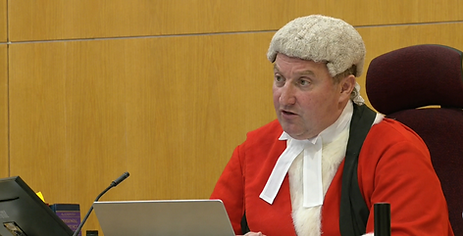
Mr Justice Johnson, judge presiding over the first Filton trial and suibsequent retrial at Woolwich Crown Court
The use of these powers has generated significant legal and political debate. Because the terrorism connection is determined by the judge after conviction, rather than by the jury during the trial, jurors are not asked to decide whether the statutory test is met and may be unaware that a guilty verdict could place defendants within the enhanced terrorism sentencing regime. Campaign organisations, legal commentators and some parliamentarians have questioned whether Parliament intended these provisions to be used in cases of non-violent protest and have called for greater transparency over the criteria used by prosecutors and the courts. Others argue that the courts are simply applying legislation enacted by Parliament and that any change to its scope should be made by Parliament.
Reaction
Writing in The Guardian after the sentencing, barrister and human rights lawyer Geoffrey Robertson KC argued that the application of terrorism-related sentencing provisions raised concerns about open justice and the role of juries. Robertson wrote that the defendants had been convicted only of criminal damage, while the terrorism connection had neither been charged nor put before the jury, describing the resulting sentences as punishment for a "quasi-terrorist offence" that had "never been charged, never put to the jury, and never proven by the prosecution".
"Application of terrorism connection without the jury's knowledge is not in the spirit of letting the jury decide ...
... the state is manipulating the law to make examples of the defendants"
- Maud Dromgoole, Juror from first Filton trials
